This Article is Out of Date/ January 28, 2026
Can AI Strengthen Mongolia’s Disaster Prevention?

Khulan M.
January 28, 2026
January 28, 2026
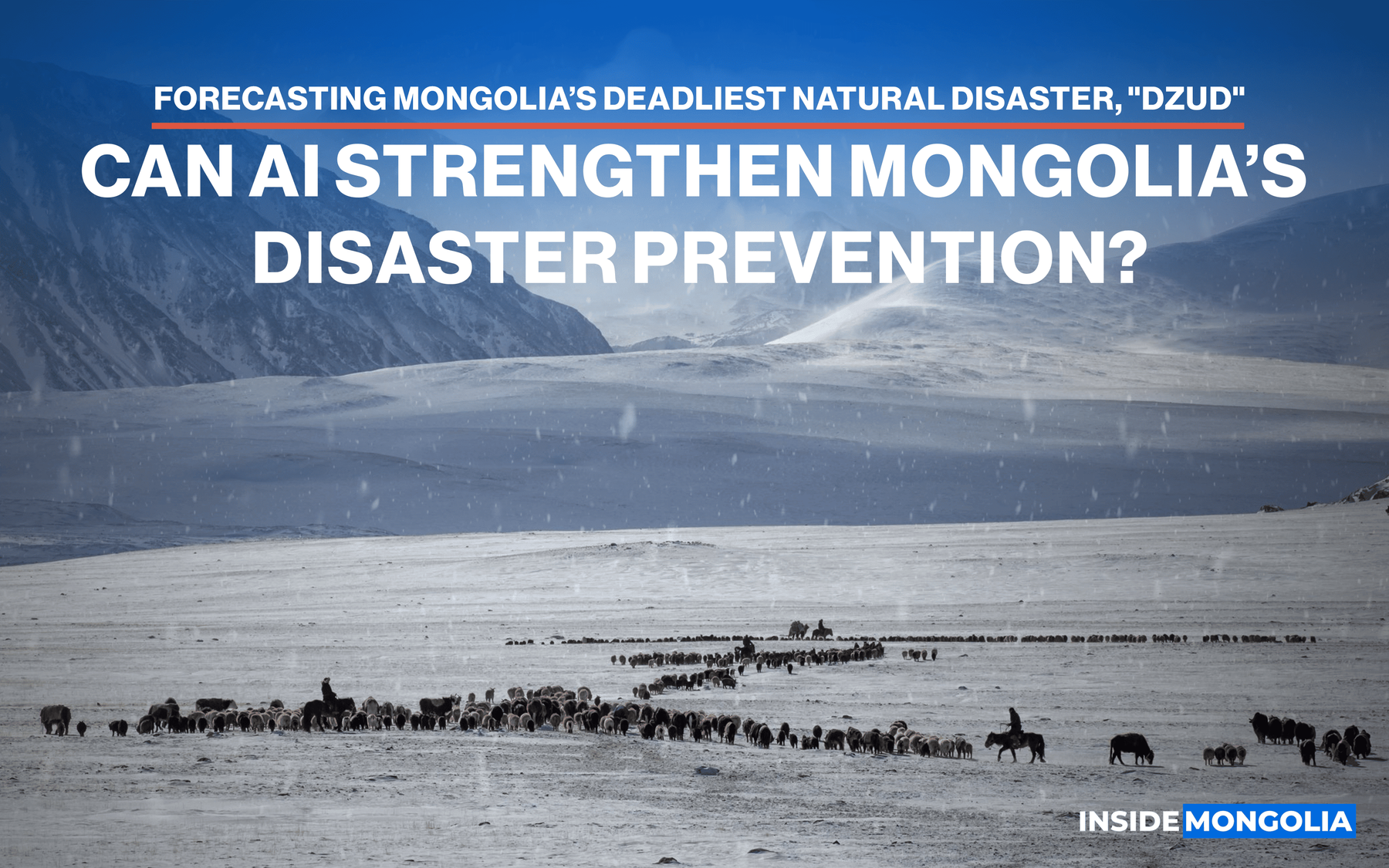
In February, at –40°C, the animals die in a specific order. First the goats, which are small and hold heat poorly. Then the sheep, heavier but quicker to starve once the grass locks under ice. Then the cattle, then the horses. The camels sometimes survive.
Deadliest Disaster in Mongolia
This is dzud, Mongolia's own disaster, and its deadliest. The herder watches it happen over weeks, on a landscape that has become a white slab from which nothing edible can be extracted. Mongolians have survived it for centuries, through mobility, through reading the sky, through cultural knowledge accumulated across generations of herding on one of the most unforgiving landscapes on earth. But by the time the government's emergency vehicles arrive, the family has already lost everything.
- And everything, for a herder, means something specific. Livestock is not just income. It is savings, collateral, inheritance, and identity accumulated over a lifetime. There is no insurance payout, no severance, no transferable skill set to fall back on. The animals die and their value dies with them, a herd worth millions of MNT in October is frozen carcasses in February, worth nothing.
- It is the closest thing to financial ruin that happens in a single season, to people who spent their entire lives building what the winter just erased. The cash grant comes in April, but it arrives after the moment that mattered. By then, the animals that represented generations of work were already gone.
The Arithmetic of Catastrophe
Historically, a dzud occurred roughly once per decade, long enough for pastures to recover, for herder families to accumulate animals again, for the economy to stabilize. Now the gap between disasters has collapsed to 6 in 10 years. Pastures do not recover. Herds do not rebuild. Families that lost livestock in 2017 were hit again in 2022 and again in 2023–2024. Each round starts from a lower base.
- The 2023–2024 dzud was the worst in 15 years. By the time the season ended, 7.4 million animals were gone, 70% of all herder families in the country were severely affected, and 80,000 children had missed school. All of it happened after the animals were already dead.
What herders have never had is a machine that could tell them in October that this particular winter, in this particular province, will be unsurvivable. That machine exists now. It has existed, in various forms, since 2015. The question of why it has not reached the herders losing everything in February is not a technical question. It is a political one, and the answer is damning.
The Data Problem That Isn't a Data Problem
Mongolia's National Agency for Meteorology and Environmental Monitoring has been collecting dzud relevant data for decades. Summer temperature and precipitation, winter snowfall and snowpack depth, pasture coverage indices from satellite imagery, ground observation from 21 provinces. The agency uses 11 parameters to build a monthly dzud risk map, a provincial-level probability assessment of where disaster is coming, updated every 30 days.
This system has existed since 2015. It works. Separately, researchers at Chuo University in Japan developed a dzud prediction index using summer climate data and global forecast models, successfully tracking historical livestock mortality spikes going back to the 1990s.
- And Mongolia’s next dzud showed the limits of prediction without preparedness. In December 2023, 2 months before peak livestock mortality, the government reported that 90% of Mongolia’s territory was already at high or extreme dzud risk. The early warning indicators were all firing. The system identified the danger correctly. But the animals still died, because knowing a disaster is coming is not the same as having the infrastructure to act on that knowledge before it arrives.
How AI Could Change Everything?
The data infrastructure for an AI-powered national dzud early warning system is not aspirational. It exists. It is sitting in government servers and research papers, fragmented, underfunded, and structurally disconnected from the people it was built to protect. What the existing system lacks is not better data. It lacks 3 things. Algorithmic integration, last-mile delivery, and pre-committed action.
Algorithmic integration means taking NAMEM's 11 parameters and running them through a model that produces a single, legible, province-level risk score every 30 days from August onward. Not a committee's assessment. Not a report filed to a ministry. A number. A color on a map. Updated automatically. Published publicly. Readable on a phone.
Last-mile delivery means that risk score reaches herders. Mongolia's mobile internet penetration is over 80%. The E-Mongolia platform already reaches 83.9% of the population with government services. The technology to push a monthly risk alert, in Mongolian, in plain language, directly to the phone of every registered herder household, is not complicated. It requires a budget line, a product decision, and someone accountable for delivering it. None of these three things currently exist in any documented government commitment.
Pre-committed action means that when the model crosses a defined threshold, a province-level dzud probability above 70% in October, hay and fodder subsidies are automatically released, destocking incentives are triggered, and emergency vehicle pre-positioning begins. Not when the animals are dying. In October, while herders can still move, sell, prepare. The IFRC has shown that every dollar spent on pre-disaster action prevents $3 to $5 in post-disaster response costs. The math is simple, and the mechanism already exists: the Red Cross moved emergency cash to high-risk provinces in advance of the 2019–2020 season using exactly this approach. What is missing is a government decision to make it national infrastructure.
The Strategy That Isn't a Strategy
Mongolia ranked 98th in the global AI Readiness Index. The national AI strategy identifies mining and energy as priority sectors for AI deployment. Disaster prevention, the use case for which Mongolia has the most data, the most urgency, and the clearest human cost, is not a priority sector. It is a cross-cutting theme, which in policy language means it is everyone's responsibility and therefore no one's budget.
In May 2025, the NEMA deputy director called publicly for a shift from reactive disaster response to proactive risk management. She said it nine months after the 2023–2024 dzud had already killed 7.4 million animals. It was the right statement. It was also a description of a system that should have existed a decade ago.
What a Serious Country Would Do
A serious commitment to AI for disaster prevention is 3 decisions, not 300.
- First: Mandate NAMEM to produce and publish a monthly AI-integrated dzud risk index from August through April, updated automatically, downloadable as open data, displayed on a public dashboard. Allocate a budget. Assign accountability. Set a deadline of October 2026. The data infrastructure already exists. This is a product decision disguised as a technical problem.
- Second: Integrate the risk index into E-Mongolia's alert system with mandatory push notifications to all registered herder households when any province crosses a defined risk threshold. The engineering work is months, not years.
- Third: Pass a Dzud Preparedness Financing Law that pre-commits government expenditures, hay subsidies, destocking incentives, emergency vehicle pre-positioning—to automatic release when the risk index crosses defined thresholds. Remove the discretion. Remove the committee. The trigger is the number. The action follows the number.
None of this requires Mongolia to develop its own AI from scratch. It requires Mongolia to do what it claims it wants to do with AI: use it as infrastructure, not as a conference theme.
The Cost of Waiting
Mongolia has warmed at 3 times the global average. A country responsible for 0.1% of global CO2 emissions is absorbing a disproportionate share of climate disruption. Dzuds historically occurred once per decade. They now occur 6 times per decade, and climate projections suggest the trend will accelerate. The 2023–2024 damage estimate of $1.5–1.9 billion for 5 provinces alone represents a catastrophic recurring drain on an economy whose entire nominal GDP runs at approximately $20 billion. These are not edge-case costs. They are a structural loss being absorbed by the population least equipped to absorb it.
The families who winter on the eastern steppe do not contribute to climate change. They do not write AI strategies. They do not attend conferences in Davos. They read the sky the way their grandparents taught them, and in a climate their grandparents would not recognize, that knowledge is no longer sufficient.
The algorithm that could save them is not missing. It is built, validated, and waiting, in research papers and NAMEM servers, to be integrated into a system that delivers information to the people who need it before the animals start dying. They have been waiting through 6 dzuds. The question is how many more winters the government needs before it decides that prediction is more valuable than response.
Comment