The MP’s recall bill debate: How Mongolians perceive it?
Khulan M.
April 13, 2026
April 13, 2026
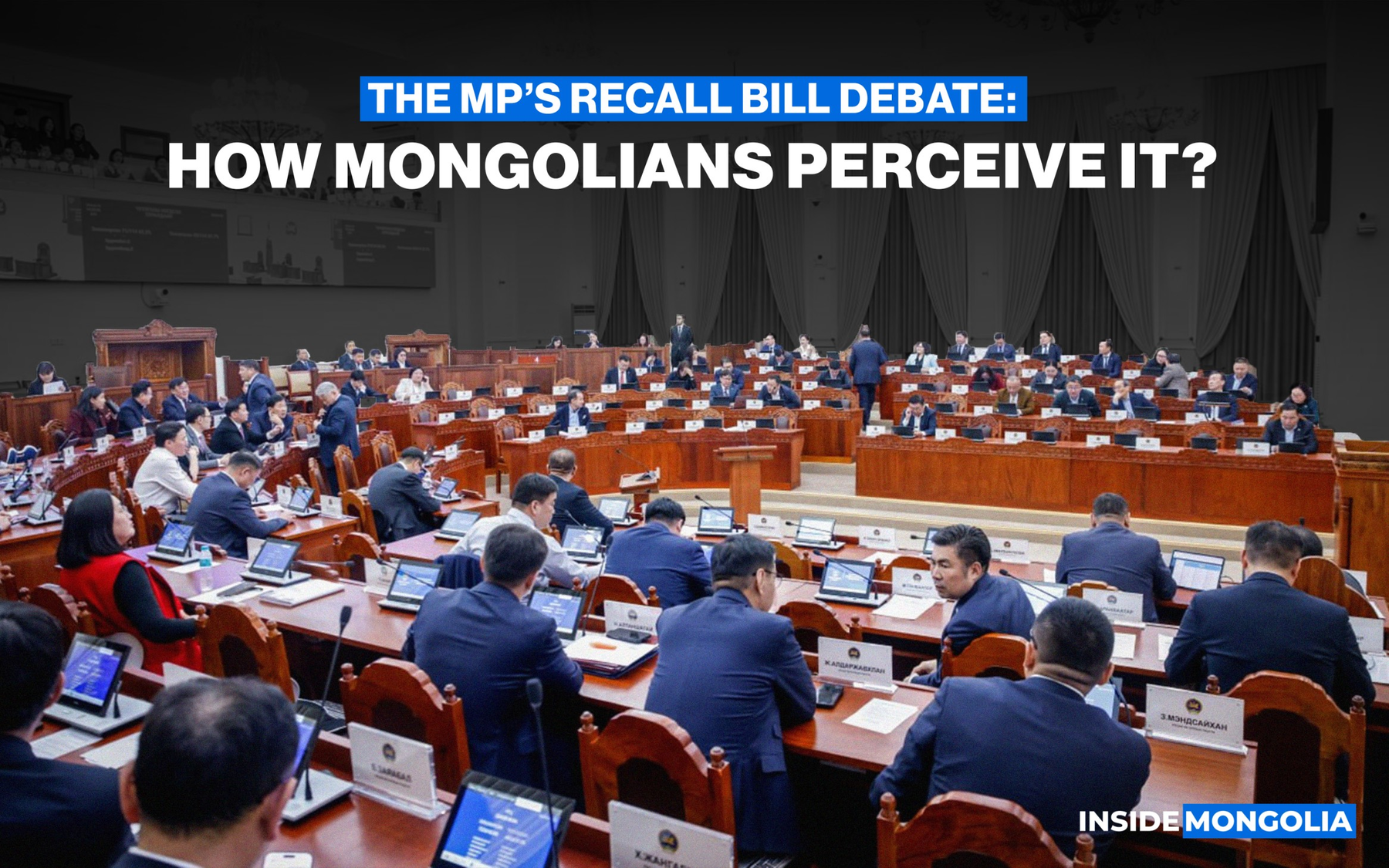
Last week, parliament saw a heated debate over whether to move forward with the President’s proposed bill on recalling members of parliament. The debate is no longer about ethics alone, but whether a law designed to improve accountability could instead weaken parliamentary independence and become a political tool.
⚖️ Where the debate stands
During the first parliamentary discussion, the President’s Office framed the bill as an effort to activate constitutional provisions that allow MPs to be held accountable for breaking their oath, violating the Constitution, repeated absenteeism, serious ethical breaches, or court-established wrongdoing. From the Presidency’s perspective, the message is straightforward: public demand for real and enforceable accountability toward underperforming lawmakers can no longer be ignored.
💦 Where the pushback lies
Critics, however, argue that the issue extends far beyond ethics. Lawmakers and legal experts have questioned whether the President has the constitutional authority to introduce legislation that directly affects MPs’ mandates, warning that it may cross institutional boundaries and undermine parliament’s independence. More broadly, concerns have been raised that the mechanism could be used to pressure dissenting lawmakers and, over time, erode parliamentary immunity, disrupt the balance of power, and create wider governance risks.
🤔 Why this matters
At the heart of the controversy is Mongolia’s three-pillar state structure: the President, the State Great Khural, and the Government. The central issue is that one institution — the Presidency — has introduced legislation that could impose accountability mechanisms on another, namely, parliament. This institutional overlap has become the core political fault line of the debate.
- 🤨 Additional concerns remain over provisions that appear to differentiate MPs based on how they were elected, while potentially granting indirect influence to the Constitutional Court and political parties, further raising questions about governance balance.
👀 The justification
Supporters of the bill argue that it is intended to strengthen accountability and create a clearer legal pathway to hold MPs responsible when they break campaign promises or act against national interests. Some have also described it as an effort to operationalize constitutional provisions that already address parliamentary responsibility.
Overall… The Democratic Party has taken a procedural pause, with the debate expected to resume next week. Since the bill was initiated by the President, Mongolia’s political orchestra has only grown louder. While strengthening MPs’ responsibility is undeniably important, the larger concern remains whether the law could evolve into a political weapon, a risk that may prove too great for the country to absorb.
Comment