Mongolia’s Commercial Bank Foreign Debt Surges 2.6 Fold in 3 Years

Khulan M.
September 14, 2026
September 14, 2026
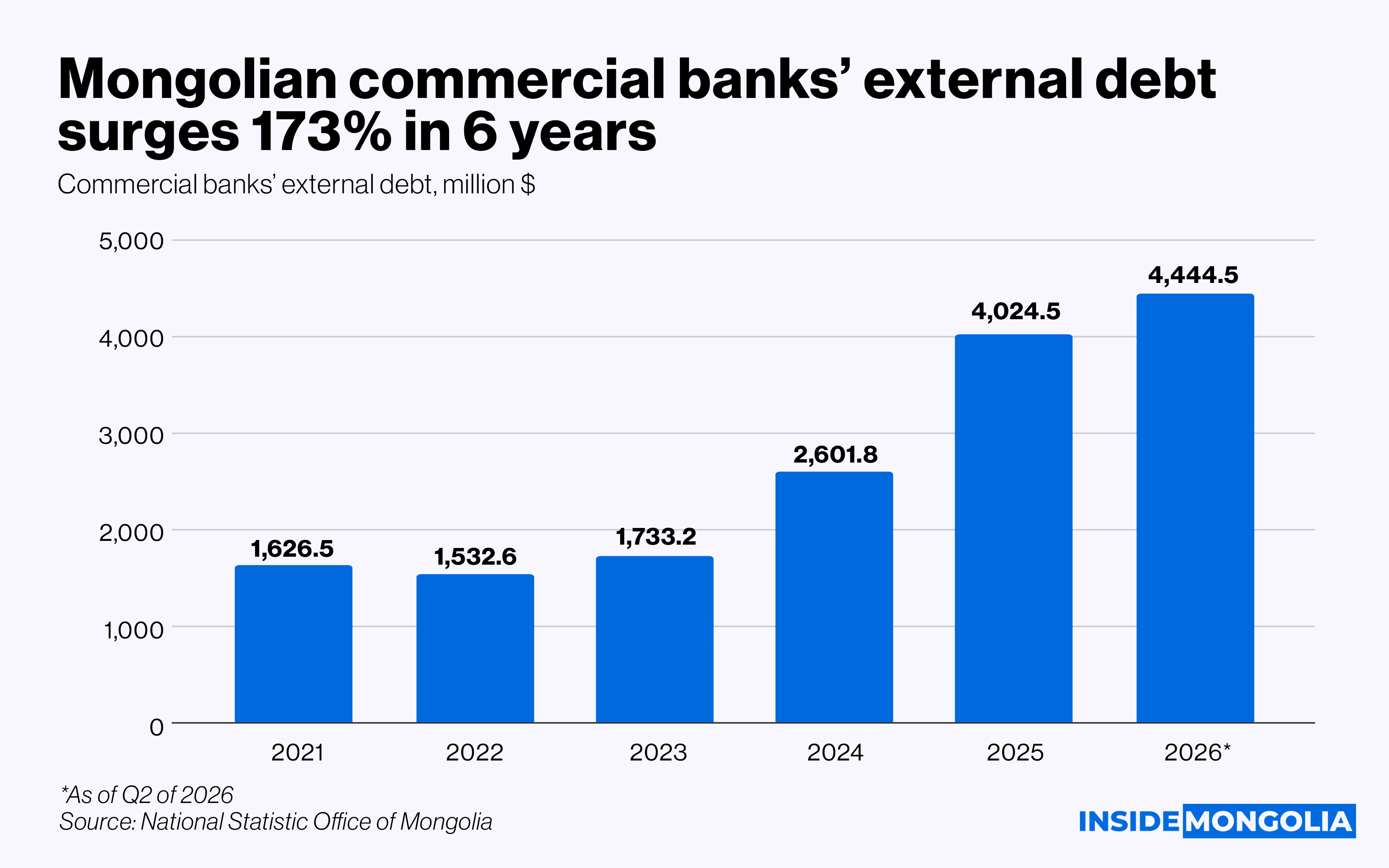
Foreign debt held by Mongolia’s commercial banks has surged 2.6-fold in 3 years, reaching $4.4 billion at the end of Q2 2026. In the past year alone, it rose $1.3 billion, or 41.2%, making banks the key driver offsetting declines in other sectors and keeping total external debt broadly stable.
Why and How Bank Debt Grew?
Commercial banks’ foreign debt remained relatively stable at $1.5-$1.7 billion between 2021 and 2023, before growth accelerated sharply. Debt rose more than 50% annually in 2024 and 2025, surpassing $4 billion in 2025. Growth slowed to 10% over the past year, though the latest figure is preliminary, making it too early to determine whether the expansion has stabilized. Banks' share of Mongolia's external debt also more than doubled, from 5.2% in 2024 to 11.4% in 2026.
Mongolia’s External Debt at a Glance
Mongolia’s total external debt reached $39.1 billion at the end of Q2 2026, up 0.4% year-on-year. By holder, foreign direct investment and intercompany lending remained the largest component at $17.6 billion, or 45% of total debt, followed by the government at $8.4 billion, other sectors at $7.6 billion, commercial banks at $4.4 billion, and the Bank of Mongolia at $1.1 billion.
- 🧩 Commercial banks were the only sector to increase foreign debt, rising 41.2%. FDI and intercompany lending fell 1.9%, government debt declined 3.2%, and the Bank of Mongolia’s foreign debt dropped 29.5%.
Meanwhile, government domestic debt jumped 60.2% to more than ₮2 trillion, pointing to a shift from foreign currency borrowing toward domestic MNT financing.
Finally… Rising bank foreign debt is not inherently negative. In a developing economy, credit demand can outpace domestic deposits, making external funding a normal financing source. The key question is not how large the debt is, but where the money goes, productive investment that expands capacity and economic returns, or consumption.
Comment